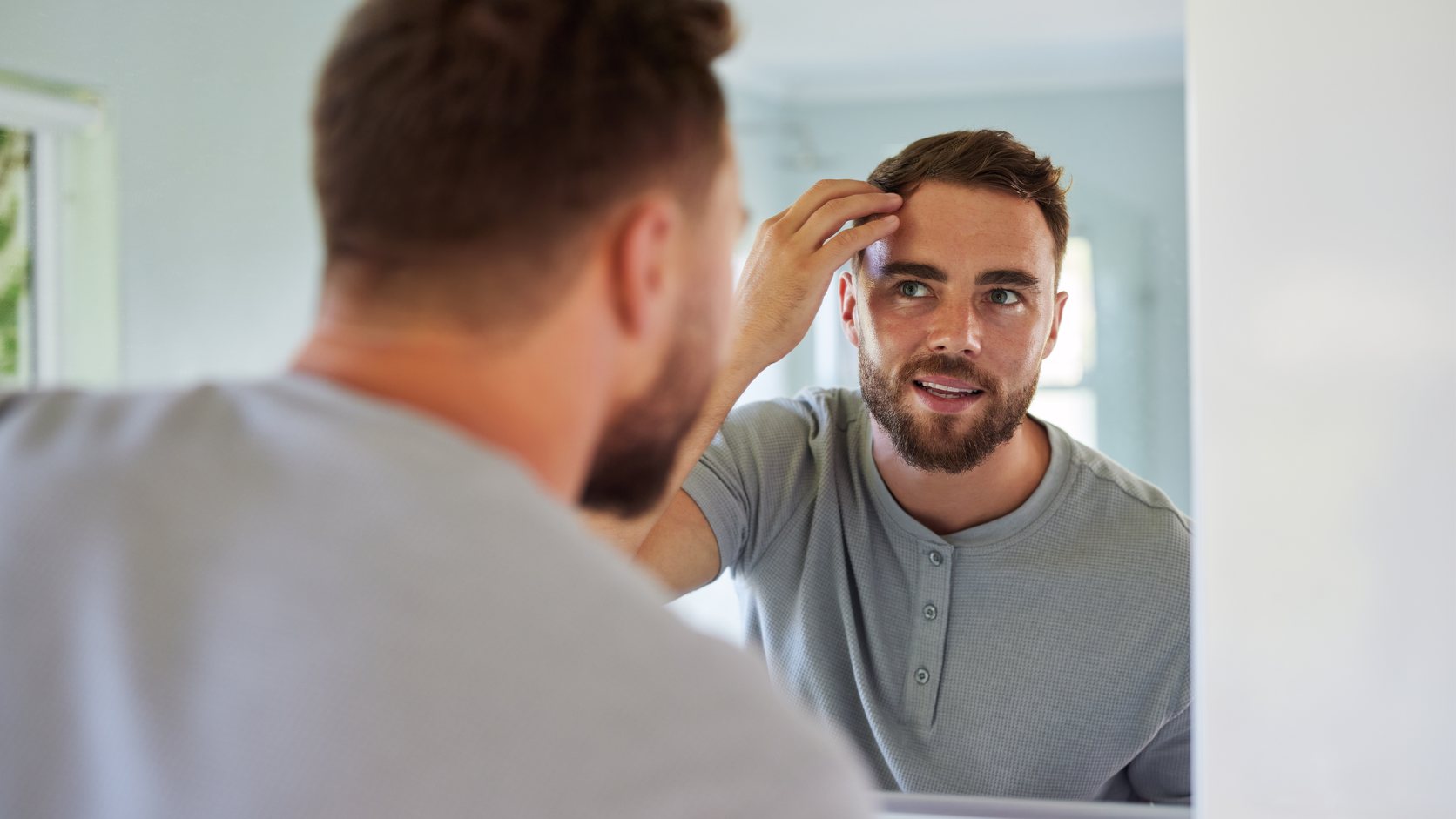
DHT (dihydrotestosterone) is a hormone your body makes from testosterone using an enzyme called 5-alpha reductase. In men with an inherited sensitivity, DHT gradually shrinks scalp hair follicles, shortening each growth phase until the hairs turn fine and stop. That process is male pattern baldness. Follicle sensitivity, not simply DHT level, decides who loses hair.
If you have searched “what is DHT”, you have probably noticed your hairline or crown changing and keep seeing those three letters blamed. This guide explains what the hormone does, why it thins hair on some men and not others, and what the evidence says about testing and lowering it. For the wider picture of causes and treatment, see our guide to male pattern baldness.
In this article
- What is DHT?
- How does DHT cause hair loss?
- Is it high DHT or sensitive follicles?
- Does high testosterone cause baldness?
- How do you know if DHT is causing your hair loss?
- Should you get your DHT levels tested?
- Can you lower DHT, and will hair grow back?
- DHT and hair loss in women
- Common DHT myths
- When to see a doctor
- Frequently asked questions
Key takeaways
- DHT is made from testosterone by the enzyme 5-alpha reductase.
- In genetically susceptible men, DHT shrinks scalp follicles over many hair cycles, so hairs grow finer, shorter and lighter until they stop.
- Sensitivity is inherited from either parent and involves over 190 genes. A high DHT or testosterone level on its own does not explain baldness.
- A DHT blood test is not used to diagnose male pattern baldness.
- Lowering DHT tends to slow loss rather than restore hair, and every medicine involved has side effects to weigh up.
What is DHT?
DHT, short for dihydrotestosterone, is an androgen: one of the hormones that produce male characteristics. A review in the Annals of Clinical Biochemistry describes it as “the most potent natural androgen in humans”. It binds to the androgen receptor more strongly than testosterone does.
How is DHT made?
Your body converts testosterone into DHT using an enzyme called 5-alpha reductase. It comes in two forms, type 1 and type 2, and both are found in adult scalp. Hair follicles contain type 2, the form most closely linked to male pattern hair loss.
What does DHT do in the body?
DHT does its most important work before you are born and during puberty. It shapes the development of male genitals in the womb, and at puberty it contributes to the growth of facial and body hair and of the prostate. According to Cleveland Clinic, DHT “doesn’t play a significant role in maintaining male physiology in adulthood”. The same hormone that gave you a beard at 16 can thin your scalp at 26: follicles in different places respond to it in opposite ways.
How does DHT cause hair loss?
DHT doesn’t make hair fall out overnight. It changes how the follicle behaves over many growth cycles.
What is hair follicle miniaturisation?
The British Association of Dermatologists (BAD) explains that in male pattern hair loss, DHT causes affected follicles to shrink. The hairs they produce become “gradually thinner and lighter in colour until eventually the follicles shrink completely”. Thick terminal hairs are replaced by fine, pale vellus-like hairs, like the fuzz on your forehead. One explanation is a shrinking dermal papilla, the cluster of cells at the base of the follicle that controls growth. The finasteride Summary of Product Characteristics (SmPC) notes that balding scalp contains “miniaturised hair follicles and increased amounts of DHT”.
What happens to the hair growth cycle?
Every scalp hair cycles through growth, rest and shedding. In the BMJ’s words, with each cycle “the anagen phase becomes shorter and the telogen phase elongates”.
| Phase | What happens | Typical length (normal scalp) | What changes with male pattern hair loss |
|---|---|---|---|
| Anagen | Active growth; around 85 to 90% of scalp hairs are here at any time | 2 to 6 years | Shortened to weeks or months, so hairs never grow long or thick |
| Catagen | Brief transition as growth stops | 1 to 2 weeks | Reached sooner, because anagen is shorter |
| Telogen | Resting, then the hair sheds | About 3 months | Lengthens, so more follicles sit empty at once |
Sources: DermNet; British Association of Dermatologists; Sinclair, BMJ 1998.
The result is shorter, finer and fewer hairs, so thinning often shows as more visible scalp under bright light first.
Why does DHT affect the hairline and crown but not the back and sides?
Follicles at the back and sides of the head are, in BAD’s words, “more resistant to miniaturisation by DHT”. That is why male pattern baldness leaves a horseshoe of hair around the sides, and why transplant surgeons take donor hair from the back of the head.
Is it high DHT or sensitive follicles?
For most men, it is sensitive follicles. Male pattern baldness is inherited, and the genetics are complex:
- BAD reports over 190 linked genes, inherited from either or both parents, not just your mother’s side.
- A UK Biobank study of more than 52,000 men aged 40 to 69 identified “over 250 independent genetic loci associated with severe hair loss”.
- Two of the strongest risk regions sit on the X chromosome (around the androgen receptor gene) and on chromosome 20.
The clearest evidence that DHT is essential comes from a rare condition. Men born lacking type 2 5-alpha reductase have very low DHT, and according to the finasteride SmPC, “Men with a genetic deficiency of type II 5α-reductase do not suffer from male pattern hair loss.” In short, pattern baldness needs DHT, but whether it happens depends on how your follicles respond.
Does high testosterone cause baldness?
This is a common misconception. Bald men are not necessarily higher in testosterone. The evidence points to genetic sensitivity at the follicle, which is why two men with similar hormone levels can have very different hairlines.
Anabolic steroids or testosterone replacement therapy (TRT) raise androgen levels, which may matter if you are already susceptible. Talk it through with your GP or prescribing doctor rather than changing anything yourself.
How do you know if DHT is causing your hair loss?
There is no single test, but the pattern is usually telling:
- Recession at the temples, often into an M shape. Doctors grade how this usually progresses using the Norwood scale.
- Thinning on the crown, the area at the back of the top of your head.
- Finer, shorter, lighter hairs in those areas, while the back and sides stay thick.
- Gradual change over months and years, not sudden clumps.
- A family history of similar hair loss on either side.
BAD notes that men can notice it “at any time after puberty”, and that an earlier start may mean quicker progression.
Should you get your DHT levels tested?
Home DHT blood tests are easy to buy, but rarely useful for hair loss. A clinical biochemistry review found “little evidence for measurement of serum DHT” in managing these conditions. Your blood level doesn’t show how sensitive your scalp follicles are.
Doctors diagnose it from the pattern of loss, your history and a scalp examination, using blood tests (such as iron or thyroid checks) only if another cause seems possible.
Can you lower DHT, and will hair grow back?
Medicines that reduce DHT inhibit 5-alpha reductase. The realistic aim is to slow or stop further loss. Some men see some regrowth, but results vary and benefits last only while treatment continues.
Finasteride 1 mg is a “competitive and specific inhibitor of type II 5α-reductase”. In the UK it is licensed for male pattern hair loss in men only. It is a prescription-only medicine (POM) and, according to the MHRA, is not prescribed on the NHS and is only available by private prescription. The SmPC says hair loss usually takes three to six months to stabilise, and benefits return to baseline 9 to 12 months after stopping. Women should not use it.
Finasteride safety: the MHRA warning
The MHRA, the UK medicines regulator, warns that finasteride is associated with depression, suicidal thoughts and sexual dysfunction (such as reduced sex drive and erection or ejaculation problems), and that sexual problems may persist after treatment is stopped. Its May 2026 update adds that sexual dysfunction may contribute to mood disorders. Every pack contains a patient alert card. If you take finasteride 1 mg and develop low mood, depression or suicidal thoughts, stop it immediately and contact your doctor. Call 999 if you are at risk of harming yourself. Tell people close to you, as they may notice changes in your mood before you do.
Dutasteride inhibits both types of 5-alpha reductase. In the UK it is licensed for an enlarged prostate, so its use for hair loss is off-label. BAD says improvements “have not been convincingly shown beyond those of finasteride”, and the MHRA added a precautionary warning about psychiatric and sexual side effects to dutasteride in 2026.
Topical minoxidil does not act on DHT. The 5% solution is licensed in the UK for androgenetic alopecia in men aged 18 to 65 and is available without a prescription, though not on NHS prescription. Our guide to how finasteride and minoxidil differ explains why one targets DHT and the other does not.
Natural options such as saw palmetto have much weaker evidence; see our article on natural DHT blockers.
DHT and hair loss in women
Women make DHT too, in smaller amounts, and female pattern hair loss can involve the same pathway. It usually shows as a widening parting rather than a receding hairline, and women lose hair for many other reasons too.
The NHS is clear that “Women should not use finasteride”. If you are a woman worried about thinning, see your GP or read our guide to female pattern hair loss.
Common DHT myths
“Wearing a cap makes you go bald.” Pattern baldness is driven by genes and your follicles’ response to DHT. A cap affects neither.
“Washing your hair too often makes it fall out.” Hairs in the shower were already shedding; the NHS says losing 50 to 100 a day is normal.
“Creatine makes you bald.” This traces to a 2009 study of 20 rugby players: DHT rose 56% during a loading phase but stayed within the normal range, and hair wasn’t measured. A 2025 randomised trial of 5 g a day for 12 weeks found no change in DHT or hair density.
When to see a doctor
See your GP or a registered clinician if:
- your hair loss is sudden, patchy or in clumps
- you have an itchy, red, scaly or painful scalp
- you are losing hair from your eyebrows, beard or body
- you feel unwell, have lost weight or have been under major stress
- the loss is affecting your mood or confidence
The NHS advises seeing a GP “before thinking about going to a commercial hair clinic”.
Frequently asked questions
Does DHT cause hair loss in everyone?
No. Every adult man produces DHT, but only men whose scalp follicles are genetically sensitive to it develop male pattern baldness. That sensitivity is inherited from either parent and involves many genes, over 190 according to the British Association of Dermatologists. This is why some men keep a full head of hair into old age despite normal DHT levels, while others start thinning in their twenties.
Is DHT bad for you?
DHT is not harmful in itself. It is essential for male development in the womb and during puberty, contributing to genital development and beard and body hair growth. In adult men it plays a smaller role. Its downsides are linked to particular tissues: in susceptible men it miniaturises scalp hair, and it is also involved in prostate enlargement. Aiming to remove it entirely is neither possible nor necessary.
Can hair grow back if you lower DHT?
Sometimes, partly. Reducing DHT with a licensed medicine mainly slows or stops further loss. Some men see some regrowth, particularly where follicles are thinned rather than gone, but results vary and areas that have been bald for years rarely recover. Any medicine that lowers DHT has side effects and licensing rules, and benefits are lost after stopping, so it needs a discussion with a prescriber.
Does high testosterone mean you’ll go bald?
Not necessarily. Baldness depends far more on how sensitive your scalp follicles are to DHT than on how much testosterone you have. Men with average hormone levels can lose hair early, and men with high levels may keep theirs. Raising androgens artificially, for example with anabolic steroids or testosterone therapy, may speed loss in susceptible men, so discuss this with your GP or prescribing doctor.
Should I get a DHT blood test for hair loss?
Usually not. A blood DHT level does not show how sensitive your follicles are, and a clinical review found little evidence for measuring serum DHT in managing these conditions. Male pattern baldness is diagnosed from the pattern of loss, family history and a scalp examination. A GP may still order blood tests, such as iron or thyroid checks, if your shedding looks like it could have another cause.
Can women have DHT-related hair loss?
Yes. Women produce DHT in smaller amounts, and female pattern hair loss can involve androgen sensitivity. It usually shows as thinning on top and a widening parting rather than a receding hairline. Women’s hair loss has many possible causes, including iron deficiency and thyroid problems, so a GP assessment is the right first step. The NHS states that women should not use finasteride.
Worried about hair loss?
Start a free online consultation and a UK-registered clinician can talk you through the options.
A consultation does not guarantee a prescription. Treatment is only prescribed where it is clinically appropriate.