
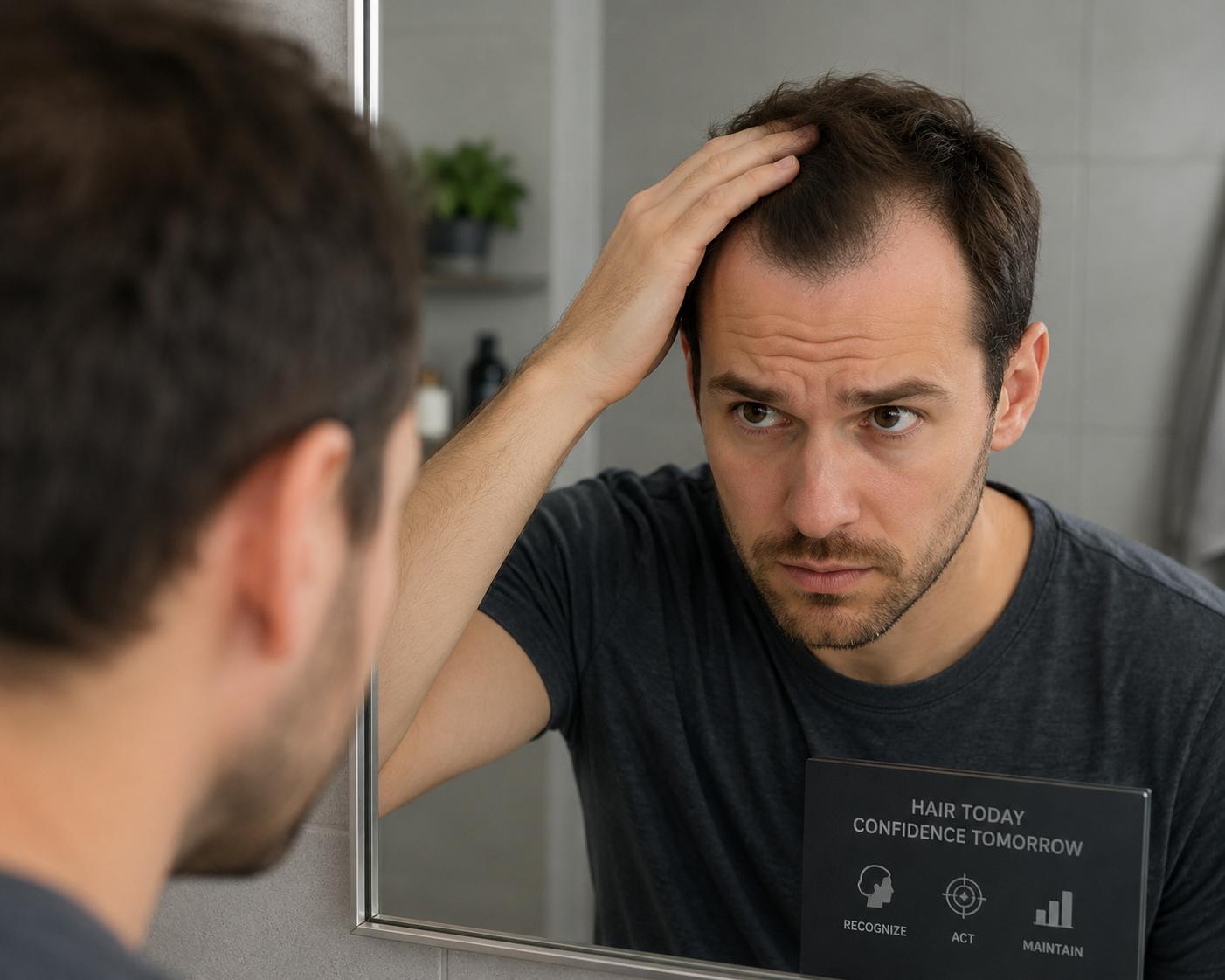
Male pattern baldness affects millions of men across the UK. It often starts earlier than people expect. If you have noticed your hairline receding or your crown thinning, you are not alone. You are also far from out of options.
This guide explains what male pattern baldness actually is and why it happens. It covers which treatments are genuinely backed by evidence. We will also look at realistic timelines and what results you can expect. We will cover when it is worth speaking to a clinician too, about a personalised hair loss consultation.
What Is Male Pattern Baldness?
Male pattern baldness, known medically as androgenetic alopecia, is the most common cause of hair loss in men. It is a genetic and hormonal condition, not an illness. Dermatologists can usually identify it at a glance, since it follows a recognisable pattern.
The hair loss typically begins at the temples or the crown. It progresses gradually over years rather than weeks. Some men notice the first signs in their late teens. For others, it does not become obvious until their thirties or forties.
Researchers have linked over 250 independent genetic loci to severe hair loss. This confirms that inherited genes heavily influence male pattern baldness, not lifestyle alone. A separate large scale UK Biobank study put the heritability of male pattern baldness at around 60 to 80 percent. Family history therefore plays a major role in whether and when the condition develops.
How Common Is Male Pattern Baldness in the UK?
Male pattern baldness is far more widespread than many people assume. UK GP data shows that around 6.5 million men currently live with some degree of male pattern baldness in Britain. Studies suggest that between 30 and 50 percent of men show signs of the condition by the age of 50.
The numbers climb steadily with age:
| Age Group | Approximate Prevalence |
|---|---|
| 18 to 29 | Around 16 percent |
| 40 to 49 | Around 40 to 53 percent |
| 50 | Up to 50 percent |
| 70 | Up to 80 percent |
These figures make one thing clear. Male pattern baldness is not a rare misfortune. For a large proportion of men, it is a near universal part of ageing. That is exactly why effective, evidence based treatment options matter so much.
Prevalence figures vary depending on how researchers collect the data. Self-reported surveys, GP records and large scale genetic cohort studies such as UK Biobank all measure slightly different things. This is why figures range from around 30 percent to over 50 percent of men by age 50. One trend stays consistent across nearly every study, though: a clear upward curve with age and a strong genetic component underneath it.
What Causes Male Pattern Baldness?
Understanding the cause helps explain why some treatments work and others do not. A combination of genetics and a hormone called dihydrotestosterone, usually shortened to DHT, drives male pattern baldness.
The Role of DHT
DHT is a byproduct of testosterone. An enzyme called 5-alpha reductase converts testosterone into DHT within the body. Every man produces DHT. But in men who carry a genetic predisposition to hair loss, the scalp’s hair follicles react unusually strongly to it.
When DHT binds to receptors in these sensitive follicles, it triggers a process called follicular miniaturisation. Over time, the follicles shrink. They produce thinner and shorter hairs, and eventually stop producing visible hair altogether. This gradual process explains why male pattern baldness tends to progress over years rather than appearing suddenly.
Genetic predisposition determines how sensitive your follicles are to DHT. This is why hair loss often runs in families. It also explains why two men with similar testosterone levels can experience very different rates of hair loss.
Many people assume high testosterone levels cause baldness, or that bald men are somehow more virile. Neither is true. Men with male pattern baldness typically have normal circulating testosterone levels. The real difference lies in how individual hair follicles respond to DHT at a cellular level. It has nothing to do with how much of the hormone the body produces overall. The British Skin Foundation notes that this genetic sensitivity, not hormone levels themselves, drives who develops pattern hair loss.
The Hair Growth Cycle Explained
To understand why hair loss happens the way it does, it helps to understand the natural hair growth cycle first. Every hair on your head moves through three distinct phases.
- Anagen (growth phase): This is the active growing stage, lasting anywhere from two to seven years. Around 85 to 90 percent of scalp hair sits in this phase at any given time.
- Catagen (transition phase): A short transitional stage lasting around two to three weeks. The follicle shrinks and hair growth slows during this time.
- Telogen (resting and shedding phase): The hair rests for roughly three months. It then sheds naturally to make way for new growth.
Losing between 50 and 100 hairs a day as part of this natural cycle is completely normal. In male pattern baldness, however, DHT progressively shortens the anagen phase and lengthens the telogen phase with each cycle. The hairs grow back finer, shorter and lighter in colour each time. Eventually this leads to visible thinning, and in advanced cases, baldness.
Why the Process Takes So Long
This cycle based understanding also explains why male pattern baldness develops so gradually. Each individual hair follicle works through its own cycle independently. The overall thinning effect therefore builds slowly across thousands of follicles over years, rather than happening all at once.
It also explains why treatment takes time to show results. Any intervention that influences the hair cycle needs several cycles to take effect. Visible change typically takes months, not days or weeks.
Recognising the Signs and Stages
Male pattern baldness almost always follows one of a small number of recognisable patterns. Dermatologists most commonly describe these using the Hamilton-Norwood scale. Stage one shows no noticeable hair loss. Stage seven represents extensive baldness, with only a band of hair remaining around the sides and back.
Common early signs include:
- A receding hairline, often starting at the temples
- Thinning at the crown or vertex of the scalp
- Increased visibility of the scalp under bright light or in photographs
- Hair that feels finer or softer than it used to
- A widening parting line
If your hairline and crown are thinning while a band of hair remains thick around the back and sides, you are likely looking at androgenetic alopecia rather than another type of hair loss. A qualified clinician remains the only reliable way to confirm this, though. Other conditions can sometimes present in similar ways.
The NICE Clinical Knowledge Summary on alopecia sets out the diagnostic features clinicians typically look for. These include the pattern of loss, the rate of progression and any associated scalp symptoms. This kind of structured assessment cannot be replaced by a mirror or a search engine, particularly when hair loss appears in an unusual pattern or develops unusually quickly.
When Should You Seek Help?
Many men wait years before addressing hair loss. Often they assume nothing can be done, or they feel uncertain about where to start. The honest answer is that earlier intervention generally gives better results. Existing treatments work best at slowing progression and preserving the hair you still have, rather than reversing advanced baldness.
The NHS notes that most hair loss does not need treatment and is often nothing to worry about. It also points out that an early assessment increases your chances of slowing or managing progressive conditions like male pattern baldness. If you are noticing early thinning and want to understand your options, booking a hair loss consultation with a clinician makes a sensible first step. It allows for a proper diagnosis before you start any treatment.
Ruling Out Other Causes
Not all hair loss is male pattern baldness. Several other conditions can cause hair thinning or shedding, and clinicians manage these differently:
- Telogen effluvium: Temporary, diffuse shedding often triggered by stress, illness, or significant life changes
- Alopecia areata: An autoimmune condition causing patchy hair loss, affecting around 1 in 170 adults in the UK
- Iron deficiency or thyroid disorders: Nutritional and hormonal imbalances that can cause hair thinning
- Scalp conditions: Such as seborrhoeic dermatitis or fungal infections like tinea capitis
- Medication side effects: Certain drugs, including some antidepressants and anticoagulants, can contribute to hair shedding
A clinician will typically ask about your family background, the pattern and speed of your hair loss, and any other symptoms before confirming a diagnosis. This matters because treatments for male pattern baldness are not appropriate or effective for these other causes.
Evidence Based Treatments for Male Pattern Baldness
No treatment is 100 percent effective for everyone, and it is worth being upfront about that. Two treatments do stand out, though, with the strongest clinical evidence behind them. Both are licensed for use in the UK.
Finasteride
Finasteride tablets work by inhibiting the 5-alpha reductase enzyme. This reduces the amount of testosterone the body converts into DHT. With less DHT reaching the hair follicles, the miniaturisation process slows considerably for many men. Some men even experience regrowth in areas of early thinning.
Clinical research has shown encouraging results. One long term Japanese study followed men over 10 years and found finasteride effective at slowing androgenetic alopecia in the vast majority of cases. Other research has reported success rates of around 70 to 80 percent in preventing further hair loss. Results vary depending on the area affected and how early treatment begins.
Finasteride Safety and Suitability
Finasteride is prescription only in the UK. It is not suitable for women, particularly those who are or could become pregnant, due to the risk of harm to a male foetus. Most men tolerate it well, though like any medicine it carries a small risk of side effects. A prescribing clinician will talk you through these. The Medicines and Healthcare products Regulatory Agency has issued safety updates on rare reports of mood related side effects. Anyone experiencing persistent low mood or changes in mental health while taking finasteride should stop and seek medical advice promptly.
Finasteride needs continuous use to maintain its effect. Stopping treatment typically leads to a gradual return to the hair loss pattern that would have occurred without it.
The American Academy of Dermatology similarly names finasteride as one of the two primary medical treatments for male pattern hair loss. It works best when started while hair loss is still relatively limited, rather than after extensive balding has already occurred. This consensus across UK and US dermatology bodies reflects a genuinely strong evidence base, not a single study or isolated opinion.
It is also worth understanding what finasteride does not do. It will not regrow hair in areas that have stayed bald for a long period, since by that stage the follicles have typically stopped functioning altogether. Its main value lies in slowing or halting further loss. In some men, it produces modest regrowth in areas where follicles are miniaturised but not yet completely inactive. Setting realistic expectations from the outset tends to bring far greater satisfaction with treatment than expecting a dramatic transformation.
Minoxidil
Minoxidil is the other main licensed treatment for male pattern baldness. It comes in both topical and oral tablet forms. Doctors originally developed it as a blood pressure medication, and discovered its hair growth effects as a side effect.
Unlike finasteride, minoxidil does not target DHT directly. Instead, it appears to increase blood flow to hair follicles and extend the anagen growth phase. This encourages follicles to produce thicker, longer lasting hairs. Minoxidil generally works best for men with mild to moderate thinning at the crown, though it can also support frontal regrowth in some cases.
You can buy topical minoxidil over the counter in pharmacies without a prescription. Oral minoxidil tablets work differently. They require a private prescription and clinical monitoring, particularly of blood pressure, since the drug was originally designed to treat hypertension. Men already taking blood pressure medication should not start it without specialist guidance.
One point worth knowing in advance: some people experience a temporary increase in shedding during the first few weeks of minoxidil treatment. This usually signals that the hair cycle is resetting, and it typically settles within six weeks. It can understandably feel alarming if you are not expecting it.
The British Association of Dermatologists notes that minoxidil response varies considerably between individuals. Some men see noticeable improvement, while others experience more modest stabilisation of existing hair. Genetic factors, the extent of hair loss before starting treatment, and consistency of use all shape the outcome. This is why clinical guidance and monitoring add real value over simply buying a product without any professional input.
Combining Finasteride and Minoxidil
Finasteride and minoxidil work through different mechanisms, addressing DHT and blood flow respectively. Because of this, many clinicians consider combination treatment for men with more established hair loss. Used together under clinical guidance, the two treatments can offer a more comprehensive approach than either used alone. Individual results still vary, and a personalised treatment plan from a qualified provider remains the only way to know what suits your specific situation.
Some clinical studies comparing combination therapy against either treatment alone have reported better outcomes for hair density and coverage when men use both together consistently. This applies particularly to men with moderate hair loss who have not fully responded to a single treatment. The rationale makes biological sense. Reducing DHT production while extending the growth phase of remaining follicles tackles two separate parts of the same underlying problem at once.
Combination treatment does mean a more involved routine, though, and a slightly higher chance of side effects from either medicine. We generally recommend discussing and monitoring this approach through a proper clinical relationship rather than managing it yourself. Some men prefer a single combined product instead, such as hair regrowth combo capsules containing both active ingredients alongside biotin, rather than juggling two separate treatments.
Hair Regrowth Sprays and Topical Treatments
Topical treatments such as a hair regrowth spray can form part of a wider treatment plan. They suit men who prefer a non-tablet option, or who want to combine topical and oral approaches. You apply these products directly to thinning areas of the scalp, and they work best as part of a long term routine rather than a quick fix.
Low Level Laser Therapy
Low level laser therapy, sometimes called red light therapy, exposes the scalp to red or near infrared light. Some studies suggest it may help stimulate hair follicles, and clinicians generally consider it a safe and painless option. However, the evidence base is considerably smaller than for finasteride and minoxidil, and the NHS does not currently fund it. Most men use it as a complementary treatment rather than a standalone solution.
Hair Transplant Surgery
Surgical hair transplantation remains an option for men with more advanced hair loss. The procedure relocates healthy hair follicles, usually from the back and sides of the scalp where hair resists DHT genetically, to thinning or balding areas. Results can look very effective and natural, but transplant surgery is not available on the NHS for cosmetic male pattern baldness. It also represents a significant financial and time investment. Most men consider it after trying medical treatments, or when hair loss has progressed beyond what medication alone can address.
What Does Not Work
Hair loss is common and emotionally significant for many men, so it is no surprise that the market is full of products making bold claims. Being a trustworthy source means being honest about what the evidence does and does not support.
- Specialised shampoos: May improve the cosmetic appearance and condition of existing hair but have not been shown to reverse androgenetic alopecia
- Biotin and most supplements: Useful if you have a genuine deficiency, but there is limited evidence they help men without one
- Scalp massage devices alone: May offer mild benefits to scalp circulation but are not a substitute for evidence based treatment
- Unregulated online “miracle” treatments: Often lack any meaningful clinical evidence and may carry unknown risks
If a product promises rapid, dramatic regrowth without mentioning the hair growth cycle or any clinical backing, treat that as a sign to be cautious.
How Long Does Treatment Take to Work?
Patience matters enormously with hair loss treatment, and this is one of the most important things to understand before starting. Hair grows in cycles lasting months, so no treatment produces overnight results.
| Timeframe | What to Expect |
|---|---|
| 0 to 6 weeks | Possible temporary increase in shedding (minoxidil), no visible improvement yet |
| 3 to 6 months | Early signs of slowed shedding, first signs of change for some men |
| 6 to 12 months | More noticeable stabilisation, some regrowth in early stage cases |
| 12 to 24 months | Maximal benefit typically seen, particularly with finasteride |
Consistency matters enormously here. Treatments for male pattern baldness work by maintaining an ongoing balance, whether that means reduced DHT production or improved follicle activity. Stopping and starting, or expecting results within a few weeks, ranks among the most common reasons men feel disappointed with otherwise effective treatments.
Is Hair Loss Treatment Available on the NHS?
This question comes up often, and the honest answer is that NHS provision is limited. The NHS does not routinely fund most hair loss treatments for cosmetic androgenetic alopecia. It generally classes this differently from hair loss caused by illness or treatment, such as chemotherapy.
You cannot get finasteride for hair loss on the NHS, even though doctors sometimes prescribe the same medicine at a different dose for prostate conditions. You can buy topical minoxidil over the counter at pharmacies without needing an NHS prescription at all. This is why many men choose to access treatment through private prescribing services instead, which allow for a proper clinical assessment and an appropriate, monitored treatment plan.
The NHS guidance on hair loss makes clear that most hair loss does not require treatment at all. For any NHS GP appointment, the priority usually centres on ruling out an underlying medical cause. Cosmetic treatment for androgenetic alopecia comes second. This represents a sensible and appropriate use of NHS resources. It does mean, though, that men wanting to actively treat male pattern baldness will generally need private prescribing routes. Ideally these still involve a thorough clinical assessment rather than an unmonitored online purchase.
Starting Treatment Safely
Finasteride and oral minoxidil are prescription medicines. Starting treatment safely means going through a proper clinical process, not simply ordering medication online without any assessment. A responsible approach typically involves:
- A detailed medical history, including family history of hair loss and any existing health conditions
- An assessment of the pattern, stage and likely cause of your hair loss
- A discussion of suitable treatment options, including realistic expectations and potential side effects
- Ongoing clinical support to monitor progress and adjust treatment if needed
A clinician follows this process during a hair loss consultation, reviewing your individual circumstances before recommending a treatment plan rather than offering a one size fits all solution.
Be wary of any service that offers prescription strength hair loss medication without any clinical assessment at all. Finasteride and oral minoxidil do not suit every man. Certain liver problems, prostate issues, or existing blood pressure medication use can all affect whether and how these treatments should be used. A genuine consultation process exists to protect you, not simply to act as a formality before a sale. Reputable providers always build this assessment into how they offer finasteride and minoxidil treatment.
Living With Male Pattern Baldness
Hair loss is not just a cosmetic issue for many men, and that is worth acknowledging openly. Research has consistently linked hair loss to feelings of reduced self-esteem and, for some men, genuine emotional distress. The NHS recognises this explicitly. It notes that hair loss affecting your wellbeing gives you a valid reason to seek support, whether that means treatment, counselling, or simply a conversation with a GP.
If hair loss is significantly affecting your confidence or mental health, raise this with a GP alongside any decision about cosmetic treatment. You do not need to manage that impact alone. NHS mental health and wellbeing services offer support if you need it.
Attitudes towards male hair loss have also shifted considerably in recent years, and that shift is worth recognising too. Many well known public figures embrace baldness openly. Shaving the head completely has become an entirely mainstream styling choice rather than a last resort. Treatment is a personal decision, not an obligation. Choosing not to treat male pattern baldness is just as valid a path as choosing finasteride, minoxidil or any other option. This guide aims to help you make an informed decision based on accurate information, whichever path you choose, rather than marketing claims or assumptions.
Frequently Asked Questions
Below are some of the most common questions we hear about male pattern baldness and its treatment. For a fuller list covering ordering, delivery and account queries, visit our main FAQs page.
At what age does male pattern baldness usually start?
Male pattern baldness can begin as early as the late teens for some men. Most men notice it more commonly in their twenties to forties. Family history remains one of the strongest predictors of when it starts.
Is male pattern baldness hereditary?
Yes. Genetic research shows that hereditary factors account for a substantial proportion of the risk of developing male pattern baldness, with hundreds of genetic markers identified as contributing factors. Either side of the family can pass it on, not only the maternal line as people commonly assume.
Can male pattern baldness be reversed completely?
Current treatments can slow progression and, in some cases, produce regrowth in areas of early thinning. No treatment guarantees a complete reversal to a full head of hair, particularly in more advanced stages. Early intervention generally gives the best chance of preserving existing hair.
What is the difference between finasteride and minoxidil?
Finasteride works internally, reducing the DHT production primarily responsible for follicle miniaturisation. Minoxidil works topically or orally, improving blood flow to follicles and extending the hair growth phase. The two work through different mechanisms, and some men use them together.
Do I need a prescription for minoxidil?
You can buy topical minoxidil over the counter in UK pharmacies without a prescription. Oral minoxidil tablets work differently. They require a private prescription and clinical monitoring due to their original use as a blood pressure medication.
Why is my hair shedding more after starting minoxidil?
An initial increase in shedding counts as a recognised and usually temporary response to starting minoxidil. People often describe it as the hair cycle resetting. It typically settles within around six weeks. If heavy shedding continues beyond this, discuss it with your prescribing clinician.
Can women use finasteride for hair loss?
No. Finasteride does not suit women, particularly those who are or could become pregnant, due to the risk of harm to a male foetus. Clinicians typically advise women experiencing pattern hair loss to discuss topical minoxidil or other suitable options instead.
Is male pattern baldness treatment available on the NHS?
Generally not, for cosmetic androgenetic alopecia. The NHS does not prescribe finasteride for hair loss, though you can buy topical minoxidil over the counter without needing any prescription at all.
How long before I see results from treatment?
Most men need at least three to six months of consistent treatment before noticing any change. Finasteride often shows maximal results after twelve to twenty four months. Hair grows in cycles, so visible change always takes time.
What happens if I stop treatment?
Both finasteride and minoxidil need ongoing use to maintain their effects. Stopping treatment typically leads to a gradual return to the pattern of hair loss that would have occurred without it, usually over the following months.
Are there any serious side effects to be aware of?
Most men tolerate finasteride and minoxidil well, but as with any medicine, side effects remain possible. The MHRA has highlighted rare reports of mood changes associated with finasteride. Anyone experiencing low mood, anxiety or thoughts of self-harm while taking it should stop and seek medical advice promptly. A clinician can talk through the full safety profile during a consultation.
How do I know if my hair loss is male pattern baldness and not something else?
Male pattern baldness typically follows a recognisable pattern of temple recession and crown thinning, while a band of hair around the back and sides stays intact. Sudden, patchy, or rapidly progressive hair loss looks different, especially alongside scalp inflammation, and warrants prompt assessment by a GP or dermatologist rather than self-diagnosis.
Final Thoughts
Male pattern baldness is an extremely common condition driven by genetics and the hormone DHT. It follows a gradual, predictable pattern in most men. No treatment works for absolutely everyone, and there are no guarantees, but finasteride and minoxidil remain the two most clinically supported options available in the UK, backed by decades of research.
Consistency over time stands out as the single most important factor in successful treatment, since hair growth operates on a cycle measured in months rather than days. Starting earlier, getting an accurate diagnosis, and following a treatment plan suited to your individual pattern of hair loss all improve your likelihood of meaningful results.
If you are noticing the early signs of thinning and want to understand your options properly, speaking to a clinician always makes a sensible starting point. You can learn more about the team behind Follicle or explore further guidance on the Follicle Journal. You can also book a hair loss consultation to get a personalised assessment of your hair loss and the treatment options that may suit you.





3 Comments