
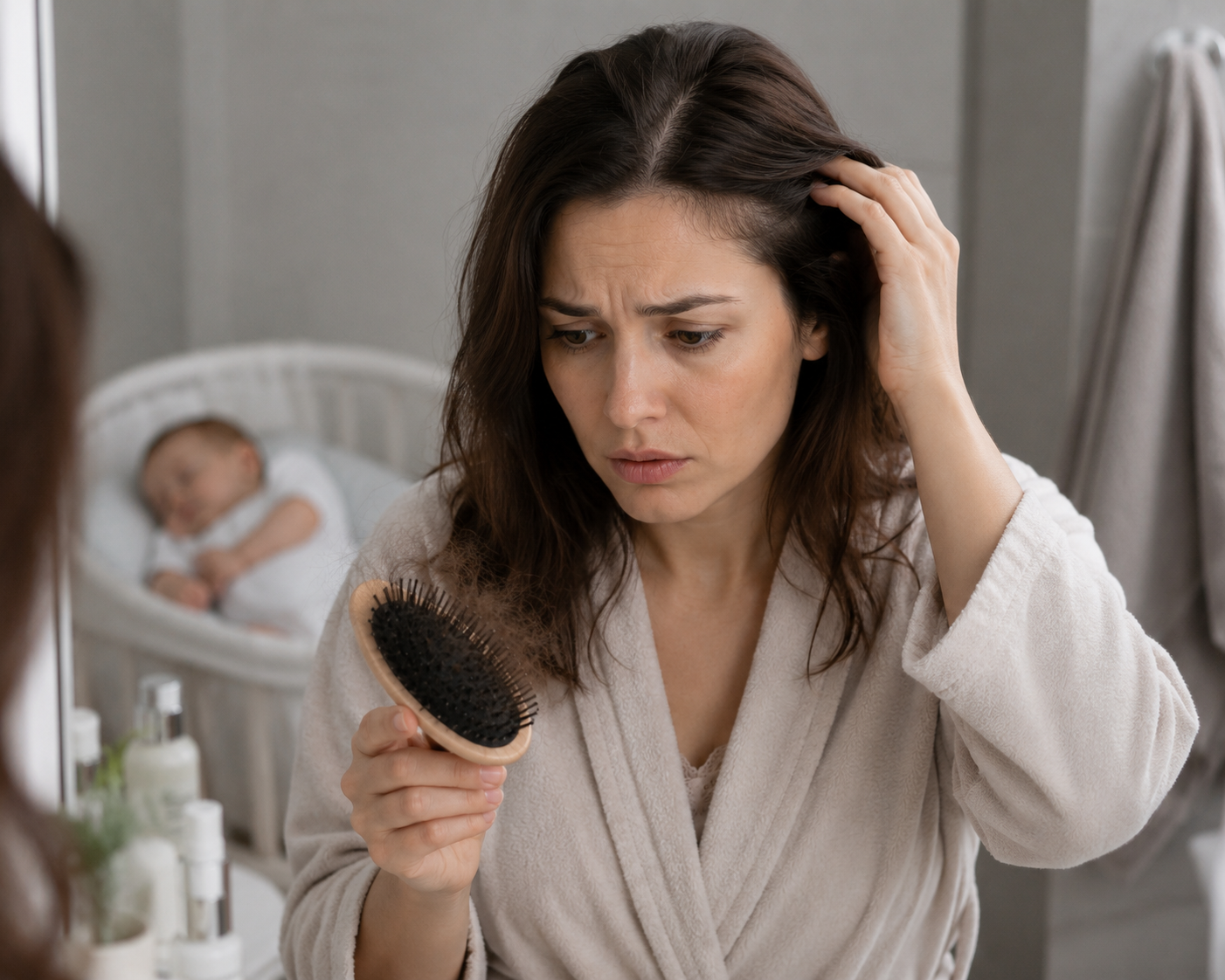
Postpartum hair loss catches many new mothers off guard. Your hair may have felt thicker than ever during pregnancy. Then, a few months after birth, you suddenly notice clumps of hair in the shower or on your pillow. If this has happened to you, please know this clearly. It is common. It has a name. In the vast majority of cases, it resolves on its own.
You are also not alone in finding it unsettling, even once you understand the biology behind it. Watching your hair thin while you are already adjusting to a new baby, recovering physically, and running on very little sleep can feel like one change too many. Understanding exactly why this happens, and how reliably it resolves, tends to take a real weight off, even before the shedding itself slows down.
This guide explains what postpartum hair loss actually is and why it happens. It covers what you can realistically expect in terms of timing and recovery. We will also look at when hair loss after pregnancy might point to something else, and when it is worth speaking to a clinician about a hair loss consultation.
What Is Postpartum Hair Loss?
Postpartum hair loss is the medical term for a type of temporary hair shedding called telogen effluvium. It happens after childbirth. It is not the same condition as female pattern hair loss. Postpartum shedding is a short term hormonal response. It is not a long term genetic process affecting the hair follicles themselves.
During pregnancy, rising oestrogen levels extend the active growth phase of the hair cycle. Hair that would normally have shed during those nine months stays in place instead. This is why so many women notice thicker, fuller hair while pregnant. After birth, oestrogen levels drop sharply. All that extra hair moves into the shedding phase at once. This produces a wave of hair loss that can feel sudden and alarming.
How Common Is Postpartum Hair Loss?
Postpartum hair loss affects a very large proportion of new mothers. Estimates suggest that around 40 to 50 percent of women experience noticeable shedding after giving birth. Some studies put the figure as high as 80 percent, depending on how researchers collected the data.
| Detail | Typical Pattern |
|---|---|
| Onset | Usually 2 to 4 months after birth |
| Peak shedding | Around 3 to 4 months postpartum |
| Duration | Typically 3 to 6 months |
| Full recovery | Usually by your baby’s first birthday |
Postpartum hair loss remains one of the more surprising parts of early motherhood for many women, despite how common it is. Pregnancy books and antenatal classes rarely mention it. This can make the experience feel isolating, even though it happens to roughly half of all new mothers.
Why Does It Catch So Many Women by Surprise?
Most pregnancy education focuses on labour, feeding and newborn care. Hair changes rarely make the list, even though they affect a huge proportion of new mothers within the first year. This gap means many women discover postpartum hair loss only once it has already started, often searching online in a moment of genuine worry. Knowing the timeline and the biology behind it in advance can make the experience feel far less frightening when it eventually happens.
There is also a quieter cultural factor at play. Hair loss conversations in general have historically centred on men, and even discussions of female hair loss tend to focus on midlife and menopause rather than the postpartum period specifically. This means many younger women have simply never heard the term telogen effluvium before they experience it themselves, despite it being one of the most common and well documented forms of hair loss in women of childbearing age.
Why Does It Happen?
The hair growth cycle has three phases. Hair spends most of its life in the anagen, or growing, phase. This can last several years. It then briefly enters the catagen, or transitional, phase. After that, it moves into telogen, the resting phase. This lasts around three months before the hair sheds naturally.
Outside of pregnancy, roughly 85 to 90 percent of scalp hair sits in the growing phase at any one time. The rest rests or sheds. During pregnancy, elevated oestrogen pushes more hair into the growing phase than usual. This delays the normal shedding that would otherwise occur. That is why hair often looks noticeably thicker by the later stages of pregnancy.
The Hormonal Trigger After Birth
Once you give birth, oestrogen levels fall rapidly back towards pre-pregnancy levels. This sudden hormonal withdrawal pushes a large batch of hair follicles into the resting phase all at once. Normally, shedding happens gradually and in a staggered way across the scalp. After birth, it does not. A few months later, those resting hairs reach the end of their cycle. They shed together. This produces the dramatic increase in hair loss many women notice around the three to four month mark.
Researchers describe this as delayed anagen release. The hair follicles were essentially overdue to enter their resting phase during pregnancy. They only catch up once oestrogen levels drop. This is a normal, self limiting biological process. It is not a sign that something has gone wrong.
Prolactin, the hormone responsible for milk production, may also play a role in this process. Research suggests prolactin can shorten the active growth phase of the hair cycle and trigger an earlier transition into the resting phase. Because prolactin levels rise sharply around birth and remain elevated during breastfeeding, some researchers believe it contributes to the timing and intensity of postpartum shedding alongside the drop in oestrogen, though the science here is still developing and not yet fully settled.
What Does Postpartum Hair Loss Look Like?
Postpartum shedding typically presents as diffuse thinning across the whole scalp. This differs from patches or a specific pattern like the receding hairline seen in male pattern baldness. Many women notice it most around the hairline and temples, since hair here tends to be finer to begin with.
- More hair than usual on your pillow, in the shower, or caught in your hairbrush
- Visible thinning across the scalp rather than in specific patches
- A hair pull test that dislodges more hairs than normal, often several at once
- No scalp redness, scaling or irritation alongside the shedding
The scalp itself usually looks completely healthy throughout. This absence of inflammation or scarring helps distinguish telogen effluvium from other causes of hair loss. Some other conditions involve visible scalp changes, which postpartum shedding does not.
Many women also notice their hair texture feels different during this period, sometimes drier or more prone to tangling than usual. This is a normal accompaniment to the shedding process rather than a separate problem, and it typically improves alongside the hair loss itself as the cycle settles back into its usual rhythm over the following months.
How Long Does It Last?
Patience really is the main treatment here. Understanding the realistic timeline helps enormously with managing the worry that comes with watching your hair thin.
Shedding usually begins around two to four months after delivery. By this point, oestrogen has had time to drop and the affected hairs have worked through their resting phase. The shedding itself typically peaks around the three to four month mark. It then gradually settles. Most women see their hair return to something close to its pre-pregnancy fullness by the time their baby turns one.
What If Shedding Continues Longer?
A smaller number of women experience a longer recovery. This applies particularly to those who breastfeed for an extended period. Some research suggests that breastfeeding beyond a year correlates with a marginally longer shedding phase. Genetics and other individual factors generally play a larger role in the overall timeline than breastfeeding alone, though.
If shedding continues well beyond a year, this is a reasonable point to seek a clinical assessment. The same applies if your hair has not started to noticeably recover by your baby’s first birthday. Persistent shedding beyond this timeframe sometimes points towards an underlying cause that needs addressing separately. This might include a thyroid imbalance or iron deficiency, rather than ongoing postpartum shedding alone.
What Causes or Worsens Postpartum Hair Loss?
The hormonal shift after childbirth drives the core process. Several other factors commonly overlap with the postpartum period, though, and can make shedding feel more pronounced.
Iron and Nutritional Deficiencies
Childbirth involves blood loss, and the body’s iron stores can take time to recover afterwards. Breastfeeding increases the demand for several nutrients further still. Low iron is a well recognised contributor to hair thinning. Many new mothers are mildly iron deficient without realising it, particularly if they experienced significant blood loss during delivery.
Other nutrients matter too. Zinc, vitamin D and biotin all play a role in healthy hair growth. Deficiencies in any of these can compound the hormonal shedding already taking place. This is one reason clinicians often suggest continuing a prenatal or postnatal vitamin through the postpartum period, rather than stopping as soon as the baby arrives.
If you experienced heavy bleeding during or after delivery, it is particularly worth mentioning this to your GP or midwife when discussing hair loss. Significant blood loss can lead to a more pronounced iron deficiency than the postpartum period typically causes on its own, and addressing this through dietary changes or iron supplementation, where appropriate, can support both your overall recovery and your hair health at the same time.
Sleep, Stress and Fatigue
The early months of parenthood bring profound sleep disruption. For many women, they also bring significant stress. Chronic stress and exhaustion can push additional hairs into the resting phase on top of the hormonal shedding already underway. This may explain why some women experience more noticeable hair loss than others, despite similar hormone levels.
This does not mean stress alone causes postpartum hair loss, and it certainly does not mean you have caused or worsened your own shedding by struggling with sleep deprivation, which is an unavoidable part of caring for a newborn. It simply means that two women with similar hormone profiles can experience quite different degrees of visible shedding, partly because of how much additional physiological stress their body is managing at the same time.
Thyroid Function
Thyroid problems become more common around pregnancy and the postpartum period. Both an underactive and an overactive thyroid can cause diffuse hair shedding that looks very similar to ordinary postpartum telogen effluvium. This overlap is exactly why prolonged or unusually severe shedding warrants a blood test, rather than an assumption that it must simply be hormonal.
Underlying Pattern Hair Loss
Sometimes postpartum shedding reveals a pre-existing genetic predisposition to thinning that pregnancy hormones had been masking. The intense shedding triggers awareness, but the underlying pattern was already there. If your hair does not fully recover within the expected timeframe, our guide to female pattern hair loss treatment covers how this distinct, longer term condition is diagnosed and treated, separately from temporary postpartum shedding.
Distinguishing between the two matters considerably for treatment. Postpartum telogen effluvium needs no active treatment and resolves on its own, while female pattern hair loss is a chronic condition that benefits from ongoing, evidence based management such as topical minoxidil. A clinician can usually tell the difference by looking at the pattern of thinning, the timeline since birth, and whether the hairline has stayed intact, since female pattern hair loss tends to follow the diffuse crown thinning described by the Ludwig scale rather than the more uniform, whole-scalp shedding typical of telogen effluvium.
Does Breastfeeding Cause Hair Loss?
This is one of the most common questions new mothers ask. The honest answer is more nuanced than a simple yes or no. Breastfeeding itself does not directly cause hair loss. The hormonal withdrawal that drives postpartum shedding happens regardless of whether you breastfeed.
That said, breastfeeding can indirectly influence the picture in a couple of ways. It increases your nutritional demands, which can worsen shedding if you are not getting enough iron, protein or key vitamins. Some women also notice that shedding continues a little longer while breastfeeding. It can pick up again around the time of weaning too, when hormone levels shift once more. Neither of these effects means breastfeeding is harmful to your hair. They simply mean your nutritional needs are higher during this period, and it is worth paying attention to them.
It is worth saying clearly that choosing not to breastfeed, or being unable to, makes no difference to whether you experience postpartum hair loss in the first place. The core trigger is the drop in oestrogen after delivery, which happens regardless of feeding choices. Women who formula feed experience postpartum shedding at broadly similar rates to those who breastfeed, even though the exact timeline can vary slightly between individuals for reasons that have little to do with feeding method.
Managing Postpartum Hair Loss
No medical treatment reverses or speeds up postpartum hair loss. The process itself is a normal part of the hair cycle resetting after pregnancy. The honest, most clinically accurate advice is simple. You do not need treatment, and your hair will most likely recover on its own.
That said, several practical steps can help your hair feel and look fuller while you wait. They can also support healthy regrowth in the meantime.
Hair Care Adjustments
None of the following steps will stop hormonal shedding outright, since that process runs on its own internal timeline regardless of what products you use. They can genuinely help your hair look and feel fuller in the meantime, though, and a few simple changes to your routine can make a noticeable difference while you wait for the shedding to settle.
- Use a volumising shampoo: Lightweight, protein-based formulas can make thinning hair appear fuller without weighing it down
- Avoid heavy conditioners: Rich conditioning formulas can leave fine, thinning hair looking limp. Apply conditioner mainly to the ends, not the roots
- Be gentle when wet: Hair is more fragile when wet. Detangle carefully and avoid aggressive brushing straight out of the shower
- Lower the heat: Reduce the temperature on hairdryers and styling tools, since hair is already more fragile during this period
- Avoid tight hairstyles: Tight ponytails, buns or braids add tension that can worsen shedding, particularly around the hairline
- Consider a shorter style: Many women find a shorter cut makes thinning hair look fuller. It is also easier to manage with a newborn
Nutrition and Supplements
Continuing your prenatal vitamin through the postpartum period can help, particularly while breastfeeding. This addresses some of the nutritional gaps that may be compounding your hair loss. If you suspect a specific deficiency, such as low iron, a simple blood test through your GP can confirm this. It also helps guide whether targeted supplementation would help.
Many women find it reassuring to know that most postnatal vitamins are designed with breastfeeding safety already in mind, which removes one layer of decision making during an already busy period. Checking the label for iron, vitamin D and B12 alongside the usual postnatal blend can help ensure you are covering the nutrients most relevant to hair health specifically, rather than relying on a general multivitamin alone.
Biotin is heavily marketed for hair health, but genuine biotin deficiency is relatively uncommon. Supplementing without a confirmed deficiency is unlikely to meaningfully change your shedding. It is generally safe, though, to take a standard postnatal multivitamin alongside a balanced diet. Always check with your GP, midwife or pharmacist before starting any new supplement while breastfeeding.
When Minoxidil Might Be Considered
Topical minoxidil is licensed for female pattern hair loss, not for postpartum telogen effluvium specifically, since the underlying mechanisms differ. For the large majority of women, postpartum shedding resolves on its own without any treatment at all. Starting minoxidil for a condition that is already self limiting is rarely necessary.
That said, hair loss sometimes persists well beyond a year. An assessment may then suggest an underlying pattern hair loss has been unmasked by the postpartum shedding. In that case, a clinician may discuss whether minoxidil could help going forward. This decision should always follow a proper hair loss consultation, rather than starting treatment speculatively. This matters particularly if you are still breastfeeding, since minoxidil use during breastfeeding should be discussed with a healthcare professional first.
When to See a Doctor
Most postpartum hair loss does not need medical attention. Certain signs suggest it is worth getting checked rather than waiting it out, though.
- Hair loss continues well beyond your baby’s first birthday with no signs of improvement
- Shedding is accompanied by extreme fatigue, dizziness or other symptoms beyond typical postpartum tiredness
- You notice patchy hair loss rather than diffuse thinning across the whole scalp
- The scalp itself looks inflamed, scaly or sore
- You have a personal or family history of thyroid disease or other hormonal conditions
Your GP may suggest blood tests to check your iron levels and thyroid function. Both are common, treatable contributors to prolonged hair shedding in the postpartum period. If pattern hair loss runs in your family, mention this too. Postpartum telogen effluvium can sometimes unmask an underlying genetic predisposition that was not obviously visible before pregnancy.
It is worth approaching this conversation without embarrassment. GPs and midwives field questions about postpartum hair loss regularly, since it is one of the most common physical changes new mothers experience in the first year. Raising it early, particularly if anything about your shedding feels unusual, costs you nothing and can rule out a treatable cause far sooner than waiting and hoping it resolves by itself.
The Emotional Side of Postpartum Hair Loss
It would be easy to treat postpartum hair loss as a purely cosmetic footnote to early motherhood. For many women, though, it adds a genuine emotional weight at an already overwhelming time. Adjusting to a new baby is demanding enough. Feeling like your body is changing in ways you did not expect makes it harder still.
It is entirely valid to feel upset or frustrated about hair loss. This holds true even while knowing intellectually that it is temporary and common. Many women describe a sense of losing control over their own appearance during a period when so much else feels out of their hands too. Talking about it often helps more than people expect. This might mean speaking with your GP, a partner, friends, or other new parents going through the same thing.
If feelings about your changing appearance start to feel disproportionate or overwhelming, please raise this with your GP or midwife. The same applies if you notice wider symptoms of low mood in the postpartum period. Postpartum mental health support exists precisely because this period can be harder than people anticipate. Hair loss is sometimes one small part of a much bigger adjustment that deserves proper attention.
Practical reassurance can help too, even if it feels small in the moment. Looking back at how common postpartum hair loss is, and how reliably it resolves for the vast majority of women, often takes some of the sting out of watching it happen to your own hair. Many women find it genuinely helps to know they are going through exactly the same experience as roughly half of all new mothers, rather than something unusual happening only to them.
Frequently Asked Questions
Below are some of the most common questions we hear about postpartum hair loss. For a fuller list covering ordering, delivery and account queries, visit our main FAQs page.
When does postpartum hair loss usually start?
Most women notice shedding beginning around two to four months after giving birth. By this point, oestrogen levels have dropped and the delayed hairs have reached the end of their resting phase.
How long does postpartum hair loss last?
Shedding typically lasts three to six months from when it begins. Most women see their hair return to its normal fullness by the time their baby turns one.
Will my hair go back to how it was before pregnancy?
For most women, yes. Postpartum hair loss is temporary. Hair density typically returns close to its pre-pregnancy state within a year. A small number of women notice their hair feels slightly different afterwards, though this varies between individuals.
Does breastfeeding make postpartum hair loss worse?
Breastfeeding does not directly cause hair loss, since the hormonal trigger happens regardless of feeding method. It does increase nutritional demands, though. Some women notice shedding lasts slightly longer while breastfeeding, or picks up again around weaning.
Is there anything that prevents postpartum hair loss?
Not entirely. The hormonal shift driving it is a normal and unavoidable part of recovering from pregnancy. Good nutrition, managing stress where possible, and avoiding additional hair damage from tight styles or excessive heat can all help limit how pronounced the shedding feels.
Should I take biotin or hair vitamins for postpartum hair loss?
Continuing a prenatal or postnatal multivitamin is generally a reasonable and safe step, particularly if you are breastfeeding. Extra biotin is unlikely to help unless you have a confirmed deficiency, so check with your GP before adding further supplements.
Can postpartum hair loss be a sign of something else?
Usually not. But persistent shedding beyond a year, patchy rather than diffuse loss, or symptoms like extreme fatigue alongside the shedding can point towards thyroid dysfunction, anaemia, or an underlying pattern hair loss unmasked by the postpartum period. Any of these warrants a GP assessment.
Can I use minoxidil while breastfeeding?
Always discuss this with a healthcare professional before starting. Minoxidil is not specifically licensed for postpartum telogen effluvium, and safety during breastfeeding needs individual clinical assessment rather than a general assumption either way.
Is it normal to lose hair in clumps rather than gradually?
Yes, this is a recognised feature of telogen effluvium. A large number of follicles entered the resting phase together after birth. The shedding can therefore feel more sudden and dramatic than ordinary day to day hair loss, even though the overall process remains temporary.
Does the sex of the baby affect postpartum hair loss?
No. No scientific evidence links the baby’s sex to the severity or pattern of postpartum hair loss. Maternal hormone changes and individual factors such as genetics and nutrition drive the shedding, not the baby.
What if my postpartum hair loss has lasted two years?
This falls outside the typical timeline, so seek a clinical assessment if you have not already. Persistent shedding at this stage is often linked to an unresolved underlying factor. This might include thyroid disease, iron deficiency, or an unrelated form of hair loss, rather than ongoing postpartum shedding alone.
Can stress from new parenthood make hair loss worse?
Yes. Chronic stress and sleep deprivation can push additional hair follicles into the resting phase, compounding the hormonal shedding already taking place. Looking after your own wellbeing, where possible, can have a small but genuine impact on this.
Final Thoughts
Postpartum hair loss is an extremely common, almost entirely temporary process. The natural drop in oestrogen after childbirth drives it. It affects roughly half of all new mothers, usually beginning a few months after birth and resolving by the time your baby reaches their first birthday.
The most accurate and reassuring advice is also the simplest, in most cases. Be patient. Look after your nutrition. Treat your hair gently while it goes through this temporary phase. If shedding continues well beyond a year, or if something about the pattern feels different from straightforward postpartum thinning, a GP assessment can rule out other treatable causes.
Above all, try not to let this become one more source of pressure during a period that already asks so much of you. Postpartum hair loss says nothing about your health, your parenting, or how well you are coping. It is simply a biological process that the vast majority of women experience and recover from completely, usually without ever needing treatment at all.
If you would like a personalised assessment of your hair loss, you can learn more about the team behind Follicle. You can also explore further guidance on the Follicle Journal, or book a hair loss consultation to discuss your individual circumstances.





Great content! Keep up the good work!