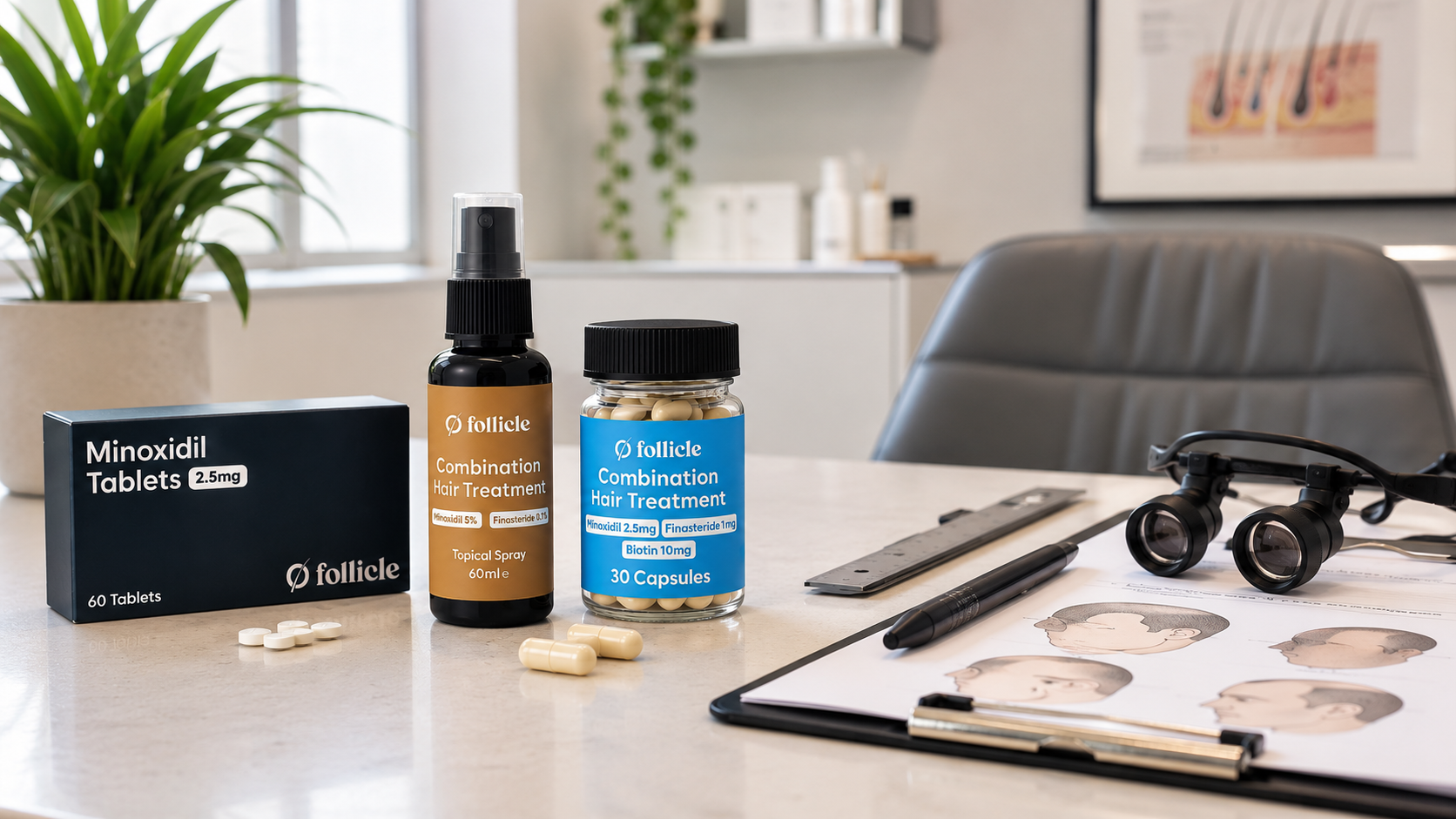
Once hair loss becomes hard to ignore, most people land on the same question. Should you start with medication, or go straight for a hair transplant? The answer depends on your stage of hair loss, your budget, and how you feel about ongoing treatment versus a one-off procedure. It is also a decision worth making with accurate information rather than whichever option a particular clinic happens to sell.
This guide walks through how each option actually works, and what they cost in the UK. It also explains why most experienced surgeons recommend a specific order, rather than picking one over the other outright. We also cover who makes a good transplant candidate, what happens if you skip medication, and how to build a realistic long-term plan that reflects your actual hair loss pattern rather than a generic sales pitch.
Table of Contents
- The Core Difference: Permanent Surgery vs Ongoing Treatment
- How Hair Transplants Actually Work
- How Medication Works: A Quick Recap
- Cost Comparison in the UK
- Side-by-Side Comparison
- Who Makes a Good Transplant Candidate?
- Signs Medication Alone May Not Be Enough
- Why Surgeons Recommend Medication Before Surgery
- What Happens If You Skip Medication After Surgery
- Timeline: Medication vs Surgery
- What Recovery From Surgery Actually Feels Like
- Risks and Downsides of Each Approach
- Common Myths About Hair Transplants
- Other Options: SMP and Low-Level Laser Therapy
- Can You Do Both? Building a Combined Strategy
- Choosing a Transplant Surgeon Safely
- Preparing for a Transplant Consultation
- Making the Decision: A Practical Framework
- Frequently Asked Questions
- Final Thoughts
The Core Difference: Permanent Surgery vs Ongoing Treatment
Medication and surgery solve different problems. Finasteride and minoxidil work with the hair you still have. They slow or stop further loss, and they can thicken and regrow follicles that have miniaturised but not disappeared completely. They do nothing for scalp areas where follicles have already died off.
A hair transplant does not create new hair follicles. It relocates existing, DHT-resistant follicles from a donor area, usually the back and sides of the scalp, into thinning or balding zones. Once transplanted, these follicles generally keep growing for life, since they retain their original resistance to DHT even in a new location.
This distinction matters more than most marketing suggests. Surgery restores hair where it has already gone. Medication protects hair that is still there. Neither one fully replaces the other, which is exactly why so many long-term hair loss plans eventually use both, rather than treating the decision as a single either-or choice made once and never revisited.
How Hair Transplants Actually Work
Two main techniques dominate UK hair transplant surgery today.
Follicular Unit Extraction (FUE)
FUE removes individual follicular units directly from the donor area, one at a time, using a small punch tool. The surgeon then implants each unit into the balding area. This technique leaves tiny, scattered scars rather than one visible line, which is why it has become the most widely used method in the UK.
Follicular Unit Transplantation (FUT)
FUT removes a strip of scalp from the donor area, then divides it into individual grafts under a microscope before implantation. This method can transplant a larger number of grafts in a single session, but it leaves a linear scar at the donor site.
What a Procedure Actually Involves
Most procedures take between four and eight hours, depending on how many grafts you need. You stay awake throughout, under local anaesthetic. Recovery involves some swelling and scabbing for around ten days, with transplanted hairs typically shedding within a month, a normal part of the process rather than a failure. New growth usually starts around three to four months later, with full results visible at twelve to eighteen months.
How Medication Works: A Quick Recap
Finasteride and minoxidil remain the two licensed medical treatments for pattern hair loss in the UK. Finasteride blocks the enzyme that converts testosterone into DHT, addressing the hormonal cause of follicle miniaturisation. Minoxidil increases blood flow to the scalp and extends the active growth phase of the hair cycle, stimulating the follicles that remain.
Both treatments need consistent, ongoing use to maintain results, and both take three to six months to show a visible effect. Our full finasteride vs minoxidil guide covers how each treatment works, who tends to respond best to each, and why combining the two often outperforms either alone.
Cost Comparison in the UK
Cost is often the deciding factor, and the gap between the two approaches is significant.
Medication Costs
Finasteride and minoxidil together typically cost between £20 and £80 a month in the UK, depending on the provider, formulation, and whether you choose a combination product. This is an ongoing cost for as long as you want to maintain results, which usually means indefinitely.
Transplant Costs
UK hair transplant surgery typically costs between £3,000 and £15,000, depending on the technique and the number of grafts required. Reputable clinics rarely charge less than £3,000, and prices below this range often signal a less experienced provider or a clinic cutting corners on staffing and aftercare.
The Long-Term Maths
A transplant looks expensive upfront, but it is typically a one-off cost. Medication is cheaper per month, but it continues for years, sometimes decades. Over a five-year period, consistent medication use often costs a similar total to a mid-range transplant. The two are not really interchangeable, though. Most people who have surgery continue medication afterwards anyway, to protect their results.
Financing and Payment Considerations
Many UK clinics offer payment plans for surgery, spreading the cost over months rather than requiring a single upfront payment. This can make the numbers look more comparable to medication month to month, though the total cost, including any interest, typically still exceeds several years of medication. Some people also travel abroad for lower surgical prices, particularly to Turkey. This can genuinely reduce cost, but it adds its own risks around aftercare, follow-up, and verifying a clinic’s standards from a distance. Factor in flights, accommodation, and time off work when comparing an overseas quote directly against a UK price, since the final gap is often smaller than it first appears.
Side-by-Side Comparison
The table below summarises the key differences at a glance.
| Factor | Medication (Finasteride/Minoxidil) | Hair Transplant |
|---|---|---|
| What it does | Protects and thickens existing hair | Restores hair in already-bald areas |
| Typical UK cost | £20 to £80 per month, ongoing | £3,000 to £15,000, largely one-off |
| Time to results | 3 to 12 months | 3 to 18 months |
| Commitment | Indefinite, to maintain results | Single procedure, plus ongoing medication advised |
| Best suited to | Early to moderate hair loss | Established bald or thinning areas with good donor supply |
| Reversibility | Effects fade if stopped | Permanent once follicles establish |
Who Makes a Good Transplant Candidate?
Not everyone suits hair transplant surgery, regardless of budget.
Adequate Donor Supply
Surgeons need enough healthy, DHT-resistant hair at the back and sides of the scalp to harvest from. People with very advanced, widespread hair loss, or naturally thin donor areas, may not have enough supply to achieve a satisfying result.
Stable Hair Loss
Surgeons generally prefer to operate once hair loss has stabilised, or is at least being actively managed with medication. Transplanting hair into a scalp where loss is still progressing rapidly risks an unnatural-looking result within a few years, as untreated areas continue thinning around the new grafts.
Realistic Expectations
A transplant restores density in the treated area. It does not deliver the exact hairline or density you had at eighteen, and it cannot fully compensate for a very limited donor supply. Surgeons who promise unlimited coverage regardless of your donor area are a warning sign worth taking seriously.
Signs Medication Alone May Not Be Enough
Medication works best on follicles that have miniaturised but not yet disappeared. A few signs suggest surgery might eventually enter the conversation, even if medication remains the sensible starting point.
Completely Bald, Shiny Patches
Skin that looks smooth and shiny, with no visible fine hairs even under close inspection, usually indicates the follicles in that area have already been lost. Medication cannot regrow hair from follicles that no longer exist, though it can still protect the surrounding areas.
Advanced Norwood Stage
People at Norwood stage five or beyond, with extensive crown and frontal loss, often find medication alone insufficient to restore meaningful coverage. It still remains useful, though, for slowing further loss and protecting what remains.
Loss That Has Been Stable for Years Without Regrowth
Medication may successfully stop further loss without producing meaningful regrowth after twelve months of consistent use. This suggests the follicles in the thinning area may already be too far gone to recover through medication alone.
None of these signs mean you should skip medication. They simply mean surgery may eventually form part of a realistic long-term plan, ideally after medication has done what it can on its own.
Why Surgeons Recommend Medication Before Surgery
Most reputable surgeons recommend stabilising hair loss with finasteride, minoxidil, or both for six to twelve months before booking surgery. This is not simply an upsell. It reflects how the two approaches interact.
Medication slows or stops loss in the untransplanted areas surrounding your donor and recipient sites. Without it, native hair around the new grafts often continues thinning. This can eventually make a well-executed transplant look patchy or uneven, even though the surgery itself worked exactly as planned. Starting medication first also gives you and your surgeon a clearer picture of how much natural regrowth you might achieve without surgery at all. This sometimes changes the treatment plan entirely.
What Happens If You Skip Medication After Surgery
Skipping medication after a transplant does not affect the transplanted follicles themselves, since they carry DHT resistance from their original donor site. It does leave your remaining native hair unprotected.
Over the following years, untreated native hair around the transplant continues to follow the same genetic pattern that caused your original hair loss. This can create a strange visual effect: permanently thick, transplanted areas surrounded by hair that keeps thinning. Many surgeons will not operate at all without a commitment to post-operative medication, precisely to avoid this outcome. If you are considering surgery specifically to avoid ongoing treatment, it is worth understanding something important. Most successful long-term results still involve medication, just alongside surgery rather than instead of it.
Timeline: Medication vs Surgery
The two approaches move at very different speeds.
Medication Timeline
Expect little visible change in the first one to two months. Early signs of improvement, such as reduced shedding, typically appear between months three and six. Full results generally take nine to twelve months, and you need ongoing use to maintain them indefinitely.
Surgery Timeline
The procedure itself takes a single day. Transplanted hairs shed within the first month, which surprises many patients but is entirely normal. Visible new growth starts around three to four months post-surgery. Results continue to mature for up to eighteen months before you see the final outcome.
What Recovery From Surgery Actually Feels Like
Understanding recovery in practical terms helps set realistic expectations if you do choose surgery.
The First Week
Expect some swelling, particularly around the forehead, in the first two to three days. Scabbing appears at the transplant sites and typically clears within seven to ten days. Most people take a week off work, partly for comfort and partly because the scalp looks noticeably red and scabbed during this period.
Weeks Two to Four
Scabbing clears fully, and the scalp starts to look normal again. This is also when transplanted hairs typically shed, a process called shock loss. It looks alarming if you do not expect it, but it does not mean the transplant has failed. The follicles remain in place under the skin.
Months Two to Twelve
New growth begins gradually, often starting as fine, thin hairs before thickening over subsequent months. Most surgeons ask patients to avoid judging results before month six, since growth genuinely takes this long to become meaningful.
Risks and Downsides of Each Approach
Both approaches carry genuine downsides worth weighing honestly.
Medication Risks
Finasteride carries a small risk of sexual side effects in some users, generally reversible on stopping. Minoxidil can cause scalp irritation and an initial shedding phase. Both require indefinite use, and stopping either one means gradually losing whatever benefit you gained.
Surgical Risks
Surgery carries the usual risks of any procedure, including infection, scarring, and results that do not match expectations. A poorly performed transplant can look unnatural, or create a visibly different texture between transplanted and native hair. Recovery also involves genuine downtime, even though the procedure itself is minimally invasive by surgical standards.
Common Myths About Hair Transplants
A few persistent myths shape how people think about surgery, often unhelpfully.
Myth: A Transplant Fixes Hair Loss Permanently and Completely
Transplanted follicles resist DHT permanently, but surrounding native hair does not, unless protected by medication. Without ongoing treatment, hair loss often continues around the transplanted area, which can undermine the overall result over several years.
Myth: You Can Have Unlimited Grafts if You Pay Enough
Donor supply is finite. Once a surgeon has harvested the safely available follicles from the back and sides of your scalp, no amount of additional payment creates more. This is why donor assessment matters so much during a consultation.
Myth: Results Look Natural Immediately After Surgery
The scalp typically looks red, scabbed, and unnatural for the first one to two weeks. Even once healed, transplanted hairs shed and regrow before reaching their final appearance, so patience through the full twelve to eighteen month timeline matters for judging the outcome fairly.
Myth: Younger Is Always Better for Surgery
Operating on very young patients, whose hair loss pattern has not yet stabilised, carries real risk. A hairline designed around hair loss at twenty-two may look increasingly unnatural by thirty-five, once surrounding areas continue thinning. Many experienced surgeons prefer to wait until hair loss has shown a clearer, more stable pattern before recommending surgery.
Other Options: SMP and Low-Level Laser Therapy
Medication and surgery are not the only routes available, though they remain the two with the strongest evidence base.
Scalp Micropigmentation
Scalp micropigmentation, or SMP, uses tattooing techniques to create the appearance of tiny hair follicles or a closely shaved head. It does not grow hair, but it can create a convincing visual effect for people with very limited donor supply. It also suits those who simply prefer a low-maintenance option over ongoing medication or surgery.
Low-Level Laser Therapy
Low-level laser therapy uses red light devices, either in-clinic or as a home cap or comb, to stimulate follicle activity. Some clinical trials show a modest increase in hair density compared with placebo devices, though the effect looks smaller and less consistent than finasteride or minoxidil. It carries very few side effects, which makes it a reasonable low-risk addition for some people. It is unlikely to work as a standalone solution for anyone beyond very early hair loss, though.
Can You Do Both? Building a Combined Strategy
Most people who achieve strong, lasting results end up using both approaches, in a specific order rather than as a single choice. This typically looks like starting medication early to slow ongoing loss. Once hair loss has stabilised and a clear bald or thinning area remains, surgery enters the picture. Medication then continues after surgery, to protect the native hair surrounding the new grafts.
This combined approach reflects what medication and surgery each do well. Medication protects what you have. Surgery restores what you have already lost. Used together, in the right order, they address pattern hair loss from both directions rather than leaving one half of the problem unmanaged.
Choosing a Transplant Surgeon Safely
If you do decide to pursue a transplant, choosing the right provider matters as much as the technique itself.
Check Credentials Properly
Confirm that skin incisions and graft extraction are performed by an appropriately trained and supervised professional, not delegated to unqualified technicians. The British Association of Hair Restoration Surgery publishes guidance on what patients should expect from a reputable UK provider. This includes who should be performing each stage of the procedure.
Be Wary of Prices That Seem Too Low
Extremely cheap transplants, whether in the UK or abroad, often mean shortcuts in staffing, aftercare, or graft quality. This does not mean every affordable clinic is a poor choice, but it does mean price should never be the only factor in your decision.
Ask About Aftercare
A reputable clinic provides clear aftercare instructions and ongoing support if complications arise. Ask specifically what happens if you experience an unexpected problem after returning home, particularly if you are considering treatment abroad.
Preparing for a Transplant Consultation
Going into a surgical consultation informed helps you get a more useful, honest assessment rather than a sales pitch.
Document Your Hair Loss History
Note when you first noticed thinning, how quickly it has progressed, and any treatments you have already tried. Photos taken over time, even casual ones, give a surgeon useful context about your rate of loss that a single snapshot consultation cannot capture.
Get Your Medical History in Order
Be ready to discuss any medications you take, existing health conditions, and previous surgeries. Certain conditions and medications can affect healing or increase surgical risk, so full disclosure helps the surgeon assess your suitability accurately.
Bring Specific Questions
Ask how many grafts the surgeon expects to use, what technique they recommend and why, and what results are realistic given your donor supply. Also ask directly who performs the skin incisions and graft extraction, since this should always be a suitably qualified professional rather than an unsupervised technician.
Get More Than One Opinion
A second consultation, ideally with a surgeon unaffiliated with the first clinic, can highlight differences in recommended technique, graft count, or price that are worth understanding before committing to such a significant cost.
Making the Decision: A Practical Framework
A few honest questions can clarify which route makes sense for you right now.
If your hair loss is early or mild, medication should almost always come first. It is cheaper, reversible in its commitment, and may be all you ever need. If you have a clearly bald or significantly thinned area that medication alone is unlikely to fill back in, surgery becomes a reasonable option. This applies especially when your donor supply looks adequate, ideally after a period of medication to stabilise the surrounding hair. If you are unsure which category you fall into, a proper clinical consultation, rather than a sales-focused surgical consultation, gives a more balanced starting point.
Frequently Asked Questions
Comparing the Two Approaches
Is a hair transplant better than medication?
Neither is universally better. They solve different problems. Medication protects existing hair, while surgery restores hair in areas where it has already gone.
Can I get a hair transplant instead of taking finasteride?
You can, but most surgeons advise against skipping medication entirely, since untreated native hair around the transplant will likely continue thinning over time.
How much does a hair transplant cost in the UK?
Typically between £3,000 and £15,000, depending on technique and graft count. Prices significantly below this range warrant extra scrutiny of the provider.
Does a hair transplant hurt?
The procedure uses local anaesthetic, so most people feel pressure rather than pain during surgery. Some soreness and tightness in the days afterwards is normal and usually manageable with standard painkillers.
Practical Next Steps
Should I try medication before considering surgery?
In almost all cases, yes. Medication is cheaper, lower risk, and may reduce or delay the need for surgery altogether, particularly if started early.
Do I need to keep taking medication after a transplant?
Most surgeons strongly recommend it, to protect the native hair surrounding your new grafts from ongoing DHT-driven loss.
How do I know if I am a good transplant candidate?
A proper assessment considers your donor supply, the stability of your hair loss, and your overall pattern. This usually requires an in-person or detailed consultation with a qualified surgeon.
Can women get hair transplants too?
Yes, though female pattern hair loss often presents as diffuse thinning rather than a clearly bald area, which can make transplant candidacy more complicated. Our guide to female pattern hair loss covers the treatment landscape for women in more detail.
What happens if a transplant does not work as expected?
Results vary between individuals, and a poor outcome sometimes requires a second, corrective procedure. This is another reason choosing an experienced, appropriately qualified surgeon matters more than chasing the lowest possible price.
Is it worth waiting until hair loss is more advanced before getting a transplant?
Not necessarily. Waiting allows surgeons to see a clearer, more stable pattern, but waiting too long can also mean losing donor hair quality or facing a larger area to cover. A clinician can help judge the right timing based on your specific pattern rather than a fixed rule.
For more on how finasteride and minoxidil work, our Help Centre covers common questions about starting treatment. It also explains whether medication alone might be enough for your stage of hair loss.
Final Thoughts
Medication and surgery are not really competing options. They serve different purposes at different stages of hair loss. For most people, particularly anyone in the earlier stages of thinning, medication offers the lower-risk, lower-cost starting point, and it may be all you ever need. Treating the two as rivals, rather than tools that can work together in sequence, is where most people go wrong when planning their approach.
The Bottom Line
If you do eventually consider surgery, going in with hair loss already stabilised by medication gives you a far better long-term result than surgery alone. The two approaches work best as a sequence, not a single either-or decision made once and never revisited. Whatever stage you are at, understanding both options properly, rather than relying on whichever one a particular provider happens to sell, puts you in a far stronger position to choose well.
If you want to understand whether medication could meet your goals before considering anything more invasive, we can help. You can start a free online consultation with Follicle in a few minutes. A licensed UK clinician will review your hair loss pattern and recommend a plan, dispensed through our GPhC-registered pharmacy. Read more about our approach on our About page.
This article is for general information only and does not replace personalised medical or surgical advice. Always seek a full assessment from a qualified clinician or surgeon before deciding on any treatment path. For further reading on hair loss and its causes, visit the NHS hair loss overview or the NICE Clinical Knowledge Summary on male pattern hair loss.